From "something might be wrong" to a validated candidate list
Veterinary teams increasingly turn to sequencing when culture and PCR panels come back inconclusive — a common situation in camelid medicine, where circulating pathogens are less characterized than in cattle or small ruminants. This client's finance and diagnostics teams had already validated Illumina-based sequencing for other applications; the open question was whether a metagenomic pipeline could reliably tell them what, if anything, was present in blood, without prior assumptions about the organism.
About the Study
A camelid health program spanning multiple herd sites ran a 40-sample pilot to evaluate shotgun metagenomics as a routine diagnostic screening tool. The objective: detect any bacteria, fungi, viruses, or parasites present in blood that could plausibly explain clinical signs of infection, using an approach sensitive enough to catch low-abundance or atypical organisms that targeted panels would miss.
The Challenge
Blood is a low-biomass, high-noise sample type
Unlike gut or environmental metagenomics, blood carries very little non-host DNA — the overwhelming majority of reads come from the camel genome itself. That creates two compounding problems for pathogen detection:
- Host DNA has to be removed thoroughly and correctly, or it drowns out the microbial signal and inflates compute cost for downstream steps.
- Whatever pathogen signal remains is often sparse, which makes it easy to either miss a real low-abundance organism or over-call background/contaminant reads as a hit.
The client's brief reflected this directly: since a well-annotated Camelus dromedarius reference genome was already available, they wanted host removal handled by direct alignment to that reference rather than any assembly-based step — and wanted the resulting taxonomic calls held to a clear confidence and coverage threshold before anything was reported as a candidate pathogen.
The GenomeBeans Approach
GenomeBeans' metagenomics pipeline was configured around the client's existing reference genome rather than a de novo step. For this cohort, the workflow ran as follows:
-
Quality control and trimming
Raw FASTQ files from each of the 40 samples (~50M read pairs each) were assessed for base quality, adapter content, duplication rate, and GC distribution before any filtering, so early anomalies in a specific sample could be flagged rather than silently propagated downstream. read QC + adapter/quality trimming
Dehosting against the camel reference genome
Trimmed reads were aligned to the Camelus dromedarius reference assembly, and any read mapping to host sequence was removed. For a blood sample, this step typically strips the large majority of total reads — it's the difference between a microbial signal that's detectable and one that's statistically invisible.reference-based host subtraction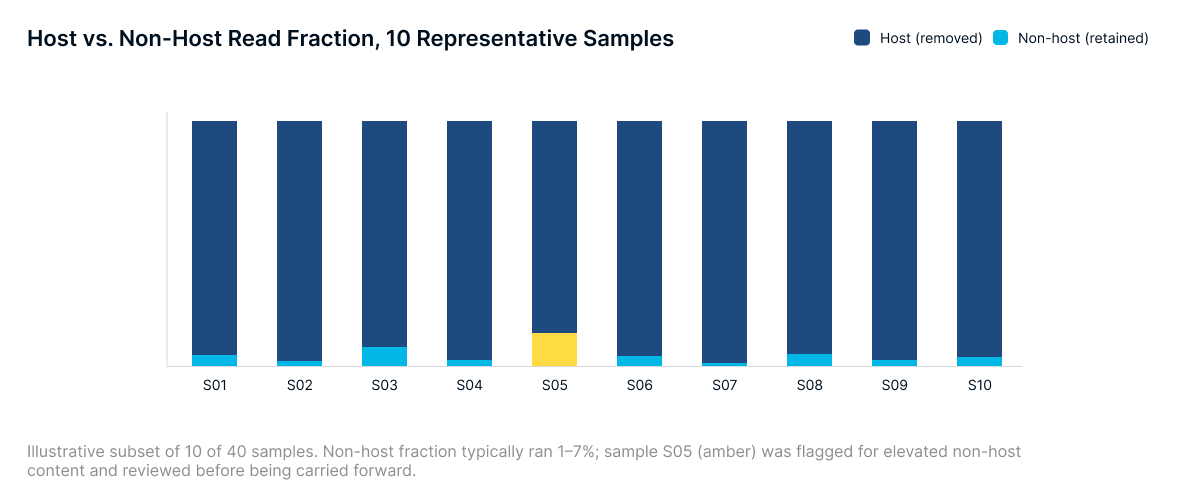
Deduplication
PCR and optical duplicates introduced during library prep were removed from the dehosted read set, correcting for the abundance inflation and false-negative risk they cause in small, low-biomass libraries.
Taxonomic classification & abundance profiling
Dehosted, deduplicated reads were classified directly against curated bacterial, fungal, viral, and parasitic reference databases, generating a relative abundance profile of every taxon detected in each sample. Working from the client's own reference genome for dehosting meant this step could run straight off clean, host-free reads rather than waiting on an assembly step.database-driven taxonomic classification
Confidence and coverage validation
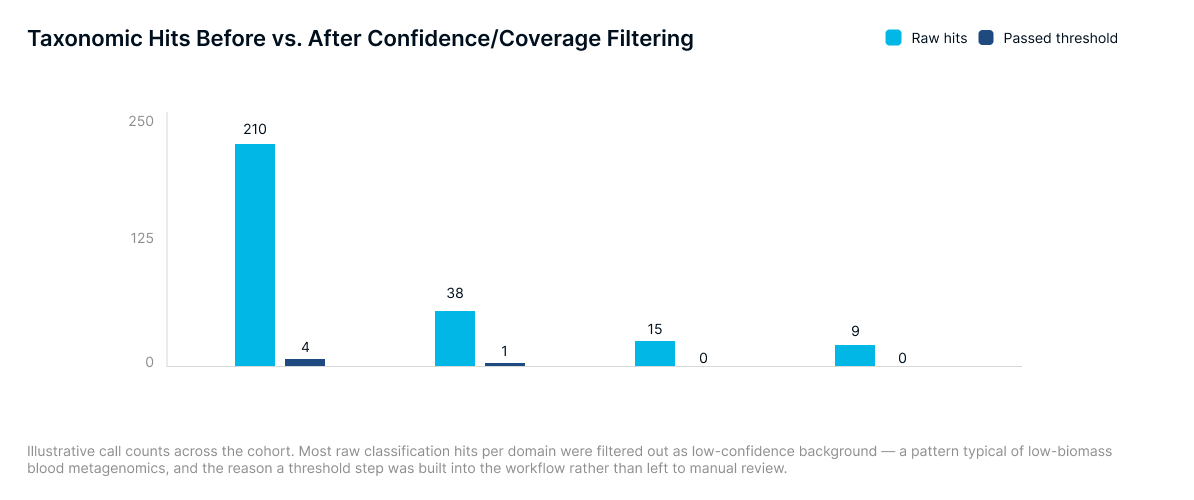
Every taxonomic call was checked against minimum read-depth and classification-confidence thresholds before being added to the candidate list, filtering out low-support hits that commonly turn up as background or lab contaminants in low-biomass blood samples. Only calls that cleared both thresholds were carried into the client's final report.threshold-based call filtering